
January 2018
Final Report – PERU Floodings 2017
Peruvian Community in Geneva.-
- Background and Project Overview:
During the 2016-17 rainy season[1] torrential rains produced flooding, river outbursts, land & mud slides that severely affected 18 of Peru´s 24 regions, including the capital city of Lima. By April 2017, nearly half the country (12 regions out of 24) had declared local States of Emergency; furthermore, the Ministry of Health had declared a Public Health Emergency in seven of these regions. To date there is still a National State of Emergency in the Piura region.

This disaster is the result of a natural phenomenon called El Niño Costero[2] which, in contrast to the «regular» El Niño (ENSO) phenomenon, cannot be predicted. According to the National Meteorology and Hydrology Service (SENAMHI), this Niño Costero was caused by an unexpected rise in sea temperature along the coast of Northern Peru which gave rise to the heavy rains, resulting in flooding, strong winds, thunderstorms, and land & mud slides. About 210,000 homes were destroyed and over one million people were affected. Affected households, mostly in poverty or extreme poverty areas, lost their means of living putting their food security at risk. Agriculture is the main source of income for most of this population. A comprehensive recovery strategy is now underway; it includes progressive rehabilitation and rebuilding with the build back better/safer approaches.
When the emergency arose (mid-March) CARE Peru was already working in the affected areas in the North of the country with an operational team on the ground with expertise in WASH, health and food security. After carrying out a needs assessment, CARE Peru defined its initial direct response strategy. Our humanitarian response began with the distribution of WASH-related kits to the most affected and vulnerable families. Given the increased risk of decease outbreaks due to expanses of stagnant waters and new breeding grounds for mosquitoes, the distribution of WASH, hygiene and dignity kits also included orientation for disease preparedness, as CARE Peru’s Zika prevention project was an integral part of our emergency response strategy.
CARE Peru identified beneficiary households in coordination with the Regional Emergency Operations Centres, local authorities and other partner institutions in the affected areas. Transport to affected areas was a major challenge during the crisis. There were no road accesses to the North and all transport needed to be done by sea or air. Government flights and navy ships were restricted to government aid, thus we had to use fishing vessels in coordination with the National Association of Fishing Industries and a commercial ship made available through the EU. Because of this situation, operative costs needed to deliver humanitarian aid were much higher than in a normal (non-critical) situation.
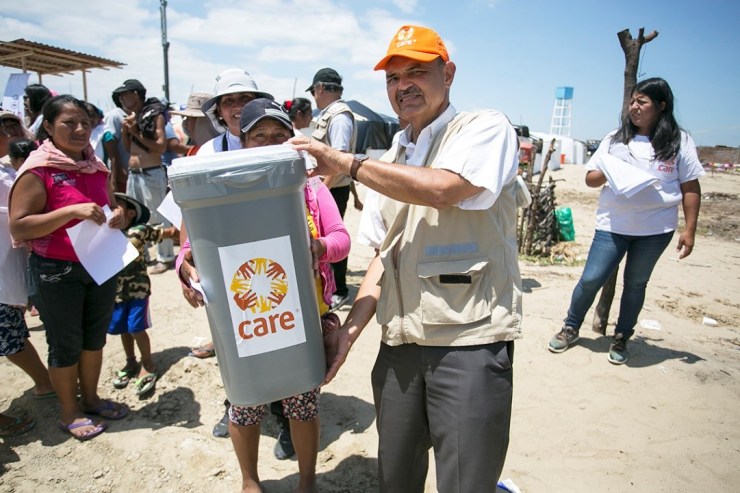
The distribution of WASH-related kits was an essential temporary action to ensure that vulnerable affected population had access to safe water and a certain minimum of hygiene conditions, to avoid an outburst of emergent diseases, even cholera. To this end, as a preparedness action, the kits also included items to protect family members from mosquito bites as the rates of mosquito borne deceases (dengue, zika & chikungunya) were expected to shoot-up, as indeed was the case.
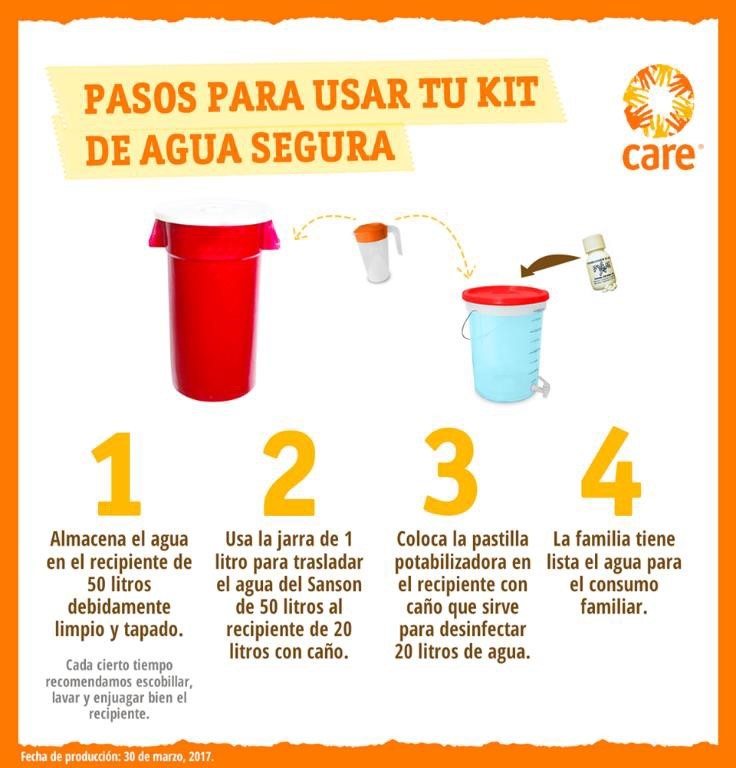
CARE Peru´s response strategy in the field was based on university volunteers (assembly, distribution and follow-up of kits); and, at the very beginning, the support of the army (warehouses, assembly of kits, security). The team (CARE staff & volunteers) responding to the emergency used a protocol to deliver these kits that included the initial assessment to validate needs; a census to identify the beneficiaries household composition (by sex and age) to address specific needs; training sessions on safe drinking water, specifically on why and how to use the purifying tablets received to ensure it was safe to drink and how to store it safely to reduce the risk of mosquito borne deceases, on how and when to wash hands (adequate hand-washing practices), and on the importance of using mosquito nets and repellents to reduce the possible impacts of mosquito bites.
After the deliveries, the households that received kits were visited by CARE volunteers (mostly university students) to make sure safe drinking water and hygiene practices were kept and to reinforce the avoidance of mosquito bites as the rates of dengue and zika viruses were steadily increasing in numbers given the weather conditions in the Coastal Niño affected areas.
Considering 5-member households the approved WASH related kits contained the following items:
[1] October through May
[2] Coastal El Niño
| SAFE WATER KITS: | HYGIENE KITS: | PROTECTION AGAINST VECTOR- BORNE DISEASE KITS: | DIGNITY KITS: |
| 1 50-litre lidded water container | 5 towels | 4 mosquito nets (1 double & 3 single sized beds) | 2 packs of sanitary packs |
| 1 20-litre bucket with a lid and tap (to distribute the water from the container) | 5 bars of hand soap | 1 can of insect repellent | 1 bag of diapers (if needed) |
| 1 1-litre jerry can | 1 large bar of laundry soap | 1 pack of condoms (3 units) | 20 shampoo sachets |
| purification tablets (month supply) | 1 kilo bag of detergent | 1 pack of wet-wipes
(100 units) |
|
| 5 tooth brushes | |||
| 2 family tubes of toothpastes |
Before delivering any kit the field team filled a detailed form where HH beneficiaries were registered by age and sex to ensure specific needs were addressed. Kits were differentiated as: regular HH (no infants, no elderly, one woman aged 12-49); HH with infants (diaper packs were included); HH with elderly; and HH with more than one girl/woman aged 12 to 49, sanitary packs varied according to the number.
By the end of our Humanitarian Phase of the Emergency Response, CARE Peru was able to deliver in total 8,130 WASH related kits to serve an equal number of households or 34,959 persons, considering a roughly average number 5 household members, see table 3.
TABLE 3
NUMBER OF KITS CARE PERU DELIVERED PER REGION[1]
| Region / Department | Number of
HH |
| Tumbes | 600 |
| Piura | 4,185 |
| Lambayeque | 910 |
| La Libertad | 2,185 |
| Ancash | 125 |
| Lima | 125 |
This would have been impossible without the support of university and army volunteers:
“The volunteers are giving us incredible support. Without them we could not do what we are doing. They have registered the population, they have assembled the kits, they are helping with the training of the population and they are doing a great job with the delivery and monitoring”
Milo Stanojevich, National Director, CARE Peru.
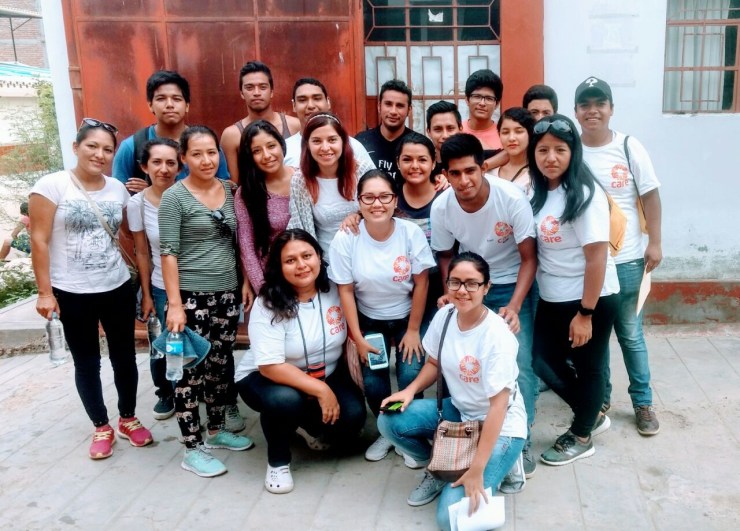
- Donation from the Peruvian Community in Geneva
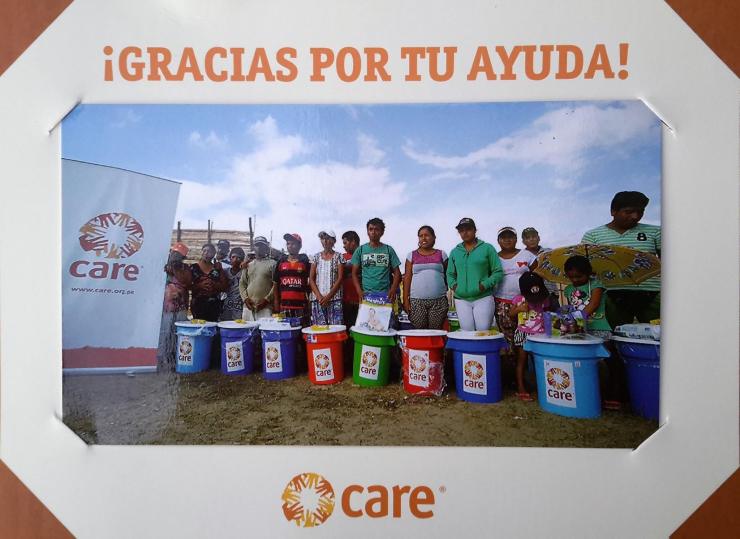
With this generous contribution, CARE Peru was able to provide direct relief to the affected population in the hardest hit rural and peri-urban settlements in the region of Piura, in the districts of Catacaos and Cura Mori (both in the lower Piura basin) where the mud floods due to the breaking of the river dyke covered the area and many people had to flee to improvised IDP camps. As an effect of this flooding, water and sanitation systems collapsed and these essential services were interrupted or very run down. We were able to deliver 234 kits to an equal number of households, directly benefiting 1010 persons, as shown in Tables 1 and 2.
| TABLE 1
DIRECT HH BENEFICIARIES PER DISTRICT |
|
| REGION OF PIURA | N° of Kits delivered |
| District of Catacaos | |
| San Pablo IDP camp site | 13 |
| Peri urban settlements around the capital: Catacaos | 37 |
| District of Cura Mori | |
| Peri urban settlements around the capital: Cura Mori , also known as Cucungará town | 184 |
| TOTAL | 234 |
| TABLE 2
DIRECT BENEFICIARIES BY AGE AND SEX PER DISTRICT
|
||||||||||
| Boys & Men
(+12)
|
Girls & Women
(12-49) |
Women
(50-65) |
Children | Elderly
(+65) |
Total
persons |
|||||
| Under 3 | 3-11 | |||||||||
| B | G | B | G | M | W | |||||
| Catacaos | 180 | 179 | 47 | 19 | 14 | 69 | 43 | 18 | 11 | 580 |
| Cura Mori | 126 | 125 | 33 | 16 | 13 | 52 | 46 | 12 | 7 | 430 |
| Sub Total | 35 | 27 | 121 | 89 | 30 | 18 | ||||
| TOTAL | 306 | 304 | 80 | 272 | 48 | 1010 | ||||
| % of Total | 30.3% | 30.1% | 7.9% | 26.9 | 4.7% | 100 | ||||
In terms of re-impregnated mosquito nets, the Ministry of Health and civil defense offices received an important number of them from OPS and other donors (USAID-OFDA) thus making an additional delivery unnecessary. The funds not invested in this activity made it possible to increase the number of kits by 67%, from 170 proposed households to 234 reached.
Thanks to this important donation, CARE Peru was able to begin lifesaving Emergency Response immediately. We were the first NGO to deliver humanitarian aid to affected households, despite the access difficulties given the disruption of the roads. Furthermore, thanks to the quick start of the intervention, CARE Peru positioned itself as an efficient humanitarian NGO which facilitated leveraging funding from institutional and private donors helping us to surpass our initial goals, both in funding and beneficiary targets.
[1] Link to video on CARE Peru’s Emergency Response: click vidéo 
24 décémbre 2017 | CARE | 
Communauté péruvienne à Genève.-
Au nom de tout CARE, je voulais remercier toute l’association genevoise pour le Pérou encore une fois de tout coeur pour votre généreux soutien et vous souhaiter d’excellentes fêtes de fin d’année et une heureuse année 2018.
Le prochain rapport du projet suivra en janvier 2018.
Avec mes meilleures salutations,
Kerstin Blidi
Swiss Fundraising Coordiantor
CARE International Secretariat

Lima, Julio de 2017 | CARE Perú |
Comunidad Peruana en Suiza
Presente.-
Su generosidad llegó a nuestros hermanos del norte.
Las inundaciones provocadas por el Fenómeno del Niño Costero en las regiones de Piura, Lambayeque, La Libertad y Tumbes, generaron una gran necesidad por parte de la población y ustedes a través de su donación han hecho posible que miles de familias reciban ayuda pronta y útil.
Los kits de agua segura e higiene han sido muy importantes para la asistencia inmediata a las familias damnificadas. Desde CARE seguimos en terreno repartiendo kits y focalizados en la segunda etapa: Proyectos de reconstrucción y rehabilitación de medios de vida que tanto se necesitan ahora.
Pueden estar confiados que su ayuda fue entregada de manera rápida y transparente a las personas que realmente han sido damnificadas por el desastre.
Estamos allí, gracias a ustedes.
Milo Stanojevich
Director Nacional
CARE Perú
Lima.-
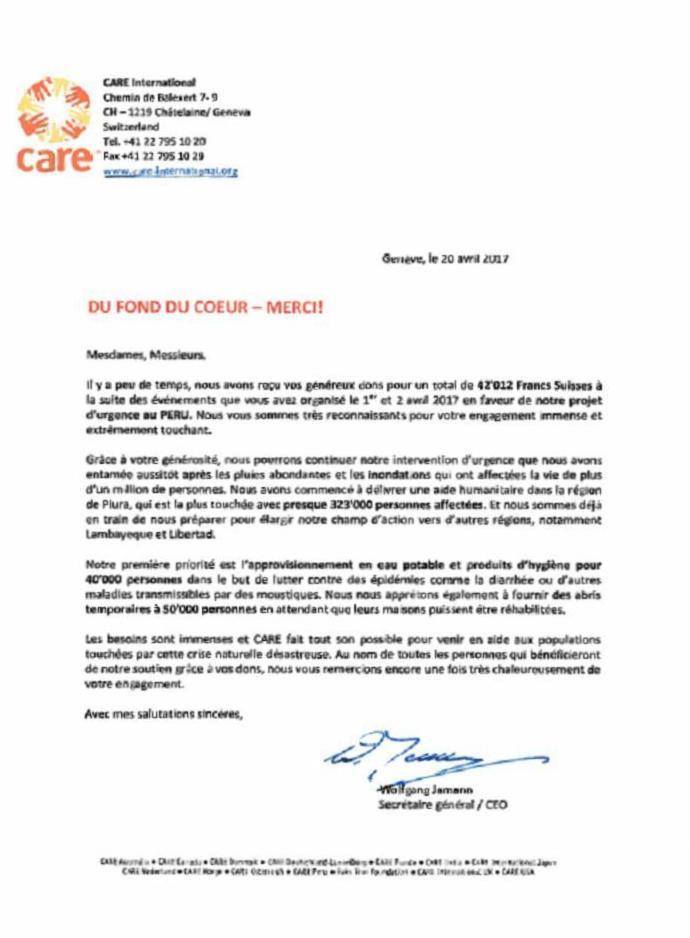
Ginebra, 20 de abril 2017
¡DEL FONDO DEL CORAZÓN – GRACIAS!
Señoras, Señores,
Hace poco tiempo, recibimos vuestras generosas donaciones por un total de CHF 42,012.- a continuación de los eventos que organizaron el 1ero y 2 de abril 2017 en favor de nuestro proyecto de emergencia en el Perú. Les estamos muy agradecidos por su compromiso inmenso y extremadamente conmovedor.
Gracias a vuestra generosidad, podremos continuar nuestras intervenciones de emergencia que emprendimos apenas pasadas las abundantes lluvias e inundaciones que afectaron la vida de más de un millón de personas. Hemos comenzado a entregar ayuda humanitaria en la región de Piura, que es la más sentida con casi 323,000 personas afectadas. Y ya estamos preparándonos para expandir nuestro campo de acción hacia otras regiones, en particular Lambayeque y La Libertad.
Nuestra primera prioridad es el abastecimiento de agua potable y productos de higiene para 40,000 personas con el objetivo de luchar contra las epidemias como la diarrea u otras enfermedades trasmisibles por mosquitos. Estamos igualmente preparándonos a proveer albergues temporales a 50,000 personas a la espera que sus casas puedan ser rehabilitadas.
Las necesidades son inmensas y CARE hace todo su posible para llevar ayuda a las poblaciones afectadas por esta crisis natural desastrosa. En nombre de todas las personas que beneficiarán de nuestro apoyo gracias a vuestras donaciones, les agradecemos una vez más muy calurosamente por vuestro compromiso.
Con mis saludos sinceros,
Wolfgan Jamann
Secretario General / CEO
CARE International
Chemin de Balexert 7-9
CH 1219 Châtelaine / Geneva
Switzerland
Lima, 13 de Abril 2017
《 Agradezco a la comunidad peruana en Ginebra a nombre de CARE y mío personalmente, por tan maravillosa contribución. Muchísimas gracias por su arduo trabajo, generosidad y buena voluntad. 》
Nelson Gaviria Pérez
Director de Finanzas | CARE Perú |
* mensaje original:
《 I thank the Peruvian community in Geneva on CARE´s behalf and mine personally for such a wonderful contribution. Thanks so much for your hard work, kindness and goodwill. 》
Nelson Gaviria Pérez
Chief Financial Officer | CARE Perú |
➽ 5 Mai 2017
1) Résumé de l’intervention d’urgence au Pérou
Le secrétariat CARE International à Genève est premièrement le coordinateur entre les membres dans le mouvement CARE et en même temps le point de contact pour tous les membres CARE en ce qui concerne les interventions d’urgence menés par CARE dans les différents pays. CARE Pérou nous a contacté début mars pour nous indiquer la gravité des inondations dans la région de Piura dans le nord du Pérou et que suite à des évaluations approfondies sur le terrain CARE allait répondre aux besoins des personnes les plus vulnérables dans ce domaine, en étroite coordination avec d’autres partenaires.
La région de Piura a été la plus touchée par les inondations et les interventions devraient continuer jusqu’en mai. Il semble que plus de 28% des ménages touchés à travers le pays se trouvent à Piura et, de façon inquiétante, plus de 43% des cas de dengue enregistrés ont également eu lieu à Piura. Bien que notre aide ait atteint la zone sinistrée, il y a encore des défis majeurs car tout l’accès routier au nord continue d’être bloqué et la majorité des transports se déroulent par voie maritime ou aérienne.
Voici une carte avec les zones touchées par les inondations :
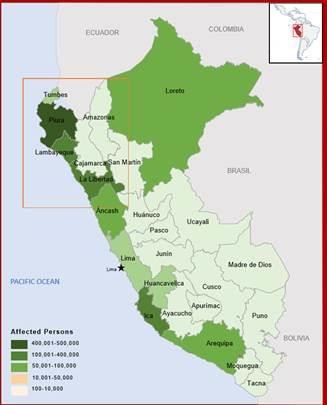
À ce jour, 18 000 personnes affectées par le débordement de la rivière Piura sont hébergées dans 40 refuges, mis en œuvre par le gouvernement régional, principalement dans les centres éducatifs et les communautés locales dans les districts de Piura, Castilla, Catacaos et Cura Mori dans le bassin inférieur de Piura. Le gouvernement régional a également distribué des articles ménagers et des produits de première nécessité. Dans le district de Catacaos, la Police nationale du Pérou (PNP) a distribué des déjeuners et des aliments et de l’eau non périssables à la population touchée. CARE a distribué des kits d’eau potable et d’hygiène à 1440 familles déplacées, soit environ 7 200 personnes.
2) Qui sont les autres acteurs humanitaires au Pérou et qui fait quoi ?
CARE Pérou fait partie de l’aide officielle coordonnée par l’OCHA (Office for the Coordination of Humanitarian Affairs des UN) qui est divisée en plusieurs secteurs (i.e. Abri, Sanitaire, Education, Protection, Récupération rapide etc.). CARE Pérou intervient dans les secteurs suivants :
- Abris
- Eau, sanitaire et hygiène (WASH- Water, sanitations & hygiene)
- Santé
Si vous souhaitez de plus amples informations, je vous joins ici le rapport d’OCHA ou vous voyez tous les projets et tous les acteurs qui participent dans cette réponse d’urgence coordonnée:
FLASH APPEAL 2017 – North Coast of Peru
3) Où est-ce que CARE Pérou intervient plus spécifiquement:
- Pour les abris, nous intervenons dans le nord de Piura, plus spécifiquement à: Chulucanas, Morropón, Buenos Aires, Malacasí dans la province de Morropón dans le departement de Piura
- Pour le WASH, nous intervenons partout dans le département de Piura
- En terme de Santé, nous allons aider à réaménager les établissements de santé du network de Catacaos dans la partie sud du département de Piura
4) Qu’est-ce qui est comprise dans notre aide humanitaire et ce que veut dire « WASH »
WASH est l’abréviation pour WAter, Sanitation et Hygiene (Eau, sanitaires et hygiène). CARE fournit des moustiquaires et des insectifuges pour aider à lutter contre l’éruption de la fièvre de dengue. Les éléments supplémentaires des kits en cours de distribution sont présentés ci- dessous:
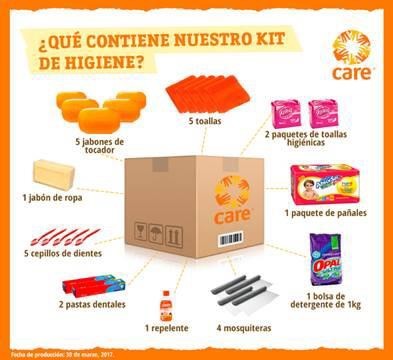
CARE Pérou fournit également des séances de sensibilisation dans des communautés dans le cadre d’un projet de prévention de la maladie de Zika et de la dengue, et cette campagne fait partie intégrante de notre intervention d’urgence. Avec un risque accru d’épidémies causées par les étendues d’eaux stagnantes et les nouveaux champs de reproduction des moustiques, la distribution des kits comprend également une orientation pour la prévention et le suivi des maladies.
5) Quels sont les prochaines étapes pour CARE Pérou?
Les coordinateurs d’urgence de CARE Pérou continuent de surveiller les événements et de se coordonner avec les équipes de terrain, le Réseau national humanitaire, les partenaires humanitaires et les agents du gouvernement. Bien que la région la plus touchée soit Piura, avec près de 323 000 personnes touchées, près de 200 000 personnes ont été affectées à Lambayeque et 141 215 personnes à La Libertad. CARE Pérou a commencé ses interventions à Piura et se prépare à intervenir dans les autres régions touchées.

L’aide globale de tous les acteurs comprend jusqu’à maintenant principalement des vêtements, des produits non périssables et de l’eau potable en bouteille, coordonnés par les gouvernements nationaux, régionaux et locaux, ainsi que par de nombreuses organisations privées et publiques, des entreprises et du grand public, réunies sous un régime national Campagne #unasolafuerza. CARE Pérou maintient son objectif de fournir 8 000 kit d’eau potable, bénéficiant à 40 000 personnes.
6) Vu d’ensemble des activités et le nombre de bénéficiaire de l’intervention d’urgence de CARE
| Secteur d’intervention | Régions | Activités | Partenaires | Cible de bénéficiaires à toucher |
| WASH | Régions de Piura, La Libertad, Lambayeque, Tumbes, Ancash et Lima | Fournir des kits d’eau potable et d’hygiène, et sensibiliser aux pratiques de protection contre les maladies transmissibles par les diarrhées et les moustiques. | Gouvernement locaux et nationaux, coordination regional avec OCHA | 40,000 |
| Abris | Regions de Lambayeque, La Libertad and Lima | Fournir des abris temporaires avec des latrines écologiques | Gouvernement locaux et nationaux, coordination regional avec OCHA | 50,000 |
| Réhabilitation des systèmes et des systèmes en termes de la subsistance et le logement. | Piura et Lambayeque | Réparation des systèmes d’eau, reconstruction du logement, opportunité de travail payé, récupération agricole | UNDP, Action against Hunger, et autres acteurs | 50,000 |
| TOTAL nombre de bénéficiaires à atteindre | 100,000 | |||
| Total fonds nécessaires pour notre intervention | US$ 4,200,000
|
|||
🔆 Quelques informations supplémentaires depuis la page facebook:
- https://www.facebook.com/CAREenPeru/photos/pb.175493615807587.- 1493996430./1528928993797369/?type=3&theater
🔆 et depuis le site web:
🔆 más información:
➽ Marzo 2017: Propuesta de Respuesta de Emergencia por parte de CARE Perú


¡BRAVO! #FuerzaPerú 🔆
 #FuerzaPerú